Undergraduate Degrees

B.S. in Computer Science

In this degree program, you will learn about the theory, experimentation, and engineering that form the basis for the design and use of computers. You will also have the ability to focus your studies on areas such as artificial intelligence, software engineering, data science, security, or high performance systems.

What can you do with a degree in computer science?

Students have a broad range of professional opportunities. Many students go on to pursue graduate degrees in computer science, data science, systems and software, and more. Students go on to work in fields like artificial intelligence, machine learning, data science, robotics, video game design, cloud computing, and beyond.

Top Employers of Graduates*

PNC Financial Services
BNY Mellon
Amazon
CGI
Deloitte

Top Job Titles of Graduates*

Software Engineer
Software Developer
Consultant
Full-stack Software Engineer
Developer

94.93%
post-graduation success rate*
$83,218
average annual salary*
317,700
average projected job openings per year for computer and IT occupations**

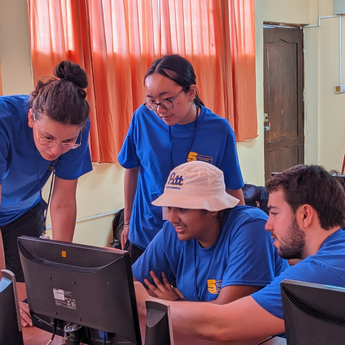
four students sitting in front of a computer monitorDegree Requirements

Graduation requirements differ among degrees. However, all degrees require a minimum of 120 passing credits with a minimum 2.00 overall GPA, completion of the School’s Foundation Courses, General Education Requirements, Major Requirements, Secondary Field of Study, and a Capstone Experience. Students must also satisfy the School of Computing and Information residency requirements.

View full bachelor's degree and general education requirements in the Pitt Course Catalog.
Accordion Container: Required Courses for the Major, CS

Required Courses for the Major

  • Loading...
 
  • Loading...
  • Loading...
 
  • Loading...
  • Loading...
 
  • Loading...
  • Loading...
 
  • Loading...

*Students should have some programming experience (usually acquired in high school) before taking CMPINF 0401. Any high school course that includes the writing of several Pascal, C++, or Java programs would be sufficient. It is also possible to take one of the department’s service courses, such as CS 0007, as preparation. Preparatory classes of this nature do not count toward the student’s major requirements.
**Students pursuing CS and a second major in in Data Science have options regarding the probability and statistics course. These students should discuss this requirement with their academic advisor.

Students must complete 18 credits or six courses of upper-level electives (numbered 1500 or higher). Internships, directed studies, capstone courses and co-op courses may not be used to satisfy this requirement (see Capstone Course section for details).

A minimum of seven credits in mathematics must be completed as follows:

  • Loading...
 
  • Loading...

Note: Students should complete their required mathematics courses early since there are pre- or co-requisites for other courses in the curriculum. Typically, MATH 0220 would be completed in the first year. Students may elect to take MATH 1180 - Linear Algebra 1 as an alternative to MATH 0280.

All computer science majors must complete a capstone experience prior to graduation. The capstone experience may be satisfied through:

  • Completion of an approved three-credit academic internship
  • Completion of an approved three-credit directed research project
  • Completion of a capstone designated course
  • Completion of at least two rotations of an approved co-op

Students are allowed to complete more than one capstone experience but a capstone course may NOT be used in place of a CS Upper-Level Elective course.

Capstone options are:

  • Loading...
 
  • Loading...
  • Loading...
 
  • Loading...

View full computer science degree requirements in the Pitt Course Catalog.

Students can also pursue a minor in computer science.

Request Information


*77.62% knowledge rate of post-graduation survey data from 2019 to 2024. More data from Pitt's First Destination Survey is available on Pitt's Career Center website. 

**This information is from the U.S. Bureau of Labor Statistics Occupational Outlook Handbook