
July 20, 2026
In the world of research, there is a particular type of individual whose work you encounter before you ever meet them. Their ideas are ever present in your reading lists, shape the questions you bring to your own projects, and subconsciously reframe the way you think about your field. For faculty and students at the School of Computing and Information (SCI), Professor David Rand of Cornell University has long been that kind of presence.
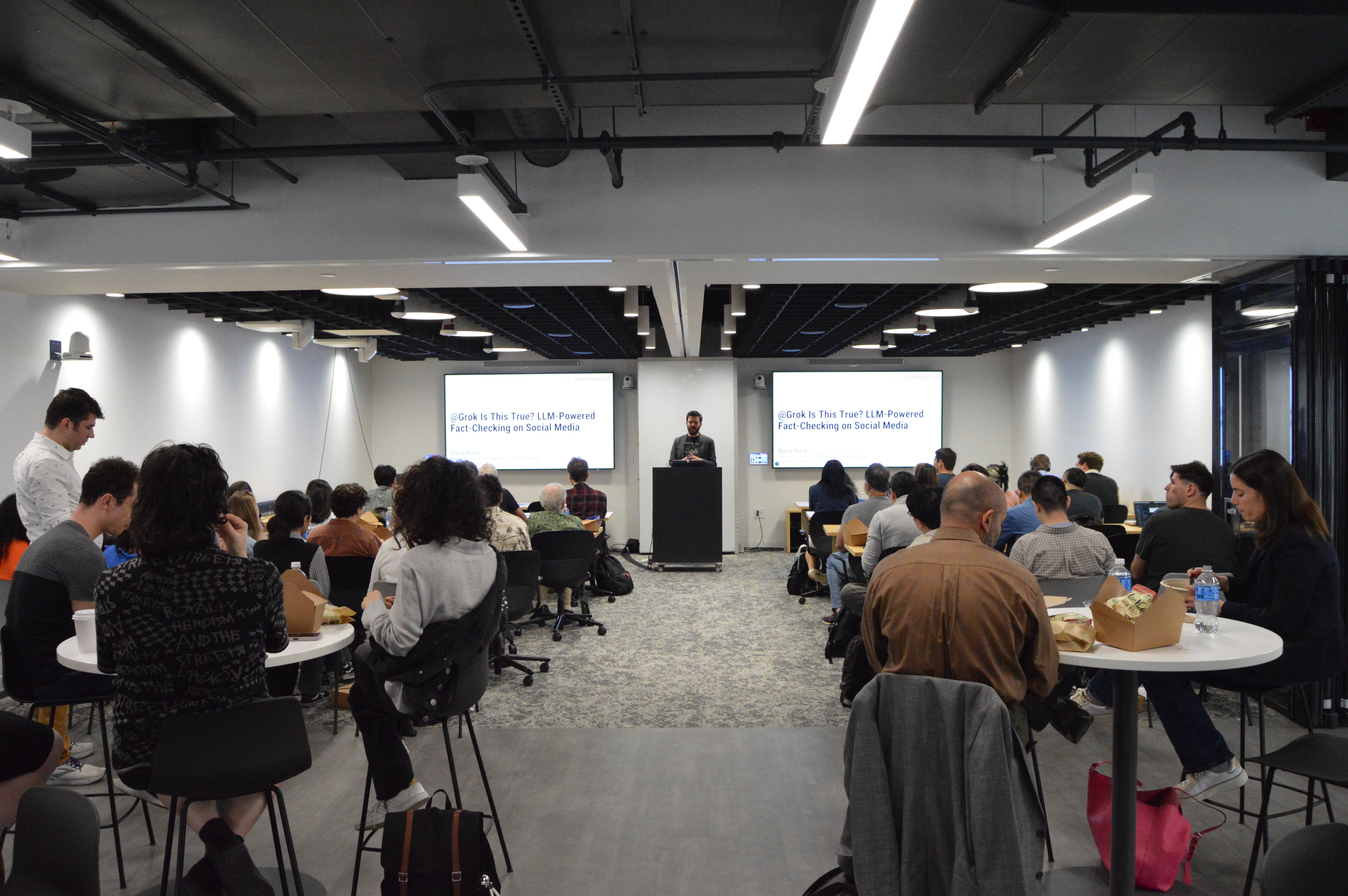 Dr. Rand is the Henrietta Johnson Louis Professor and Professor of Information Science, Marketing, and Psychology at Cornell University, where he directs the Human Cooperation Laboratory. His research sits at a unique and productive crossroads: combining the rigor of behavioral experiments with the scale of computational methods to understand how people form beliefs, cooperate with one another, and navigate a digital landscape saturated with both information, and misinformation. It is work that defies easy disciplinary categorization, drawing on psychology, political science, and data science in equal measure.
SCI researchers were drawn to Rand’s work because it mirrored many of the questions they were exploring themselves: how people engage with political information, how AI shapes attention and trust, and how online spaces influence judgment. After first connecting at the Political Networks Conference (PACSS), SCI later invited Rand to campus as an opportunity to bring those shared interests into conversation.
“His visit also created valuable opportunities for students and faculty to engage with cutting-edge research on how AI systems interact with human reasoning and decision-making,” said Ahana Biswas, a PhD student at SCI who helped organize Rand’s campus visit.
One of the most clarifying aspects of Rand’s work is the way it challenges intuitive assumptions about misinformation. The popular narrative holds that AI-generated content is ushering in a new and uniquely dangerous era of false information, that the sheer volume of synthetic media and fabricated text poses a threat unlike anything we have seen before. Rand is skeptical.
“The problem was never one of supply,” he said. “There has been a large volume of misleading content posted online for years, but no one sees most of it.”
From this perspective, AI-generated content does not fundamentally change the system as much as it adds more material to an already crowded information environment. Rand’s work shifts the focus away from simply detecting synthetic content and toward understanding the social and cognitive factors that influence what gains attention online. That approach strongly resonates with SCI researchers studying how information flows through digital spaces and shapes human behavior.
Perhaps the most urgent thread in Rand’s recent research concerns the relationship between AI systems and human reasoning. As large language models become embedded in everyday information-seeking, including answering questions, summarizing news, flagging false claims, the question of whether they make us better or worse thinkers has moved from theoretical concern to practical urgency.
For researchers at SCI studying how people interpret AI-generated explanations and fact-checking information, this distinction offers a principled framework for evaluating the systems they build and study.
“Persuading someone to have beliefs that align with evidence is helping them. Persuading them to favor one side when evidence is equivocal is manipulation,” said Rand.
A Collaboration Born from Curiosity
What makes Rand’s visit to SCI feel genuinely meaningful is the degree to which his intellectual trajectory mirrors questions that have been developing independently within the school. A workshop with computer scientists, he has said, directly catalyzed his thinking about how generative AI could help correct misconceptions. Hearing what others were working on changed what he wanted to study.
That origin story resonates at SCI, where interdisciplinary exchange is not just an aspiration but a practical necessity. The questions that animate the school’s research, how people seek out information, how algorithms shape attention, how trust is built and eroded in digital environments, do not belong to any single discipline. They require exactly the kind of bridge-building between social science, cognitive science, and computer science that Rand’s career exemplifies.
“It is relatively easy to study what happens when you force people to interact with content in an experiment. It is much harder to understand how exposure occurs in the wild,” said Rand.
His visit created space for students and faculty to engage with those questions directly, to probe the boundaries of what behavioral experiments can and cannot tell us, and to think together about what the next generation of computational social scientists should prioritize.
“For students and researchers at SCI, exposure to this kind of interdisciplinary work encourages new ways of thinking about the relationship between technology and society,” Biswas stated.
That gap between the laboratory and the wild is where much of the most important work remains to be done. It is also, not coincidentally, where the interests of SCI’s researchers and Dr Rand’s converge most clearly. His presence at SCI was a reminder that the best scholarly conversations are not performances of expertise, they are genuine encounters between people working on the same hard problems from different angles, finding in each other’s methods and perspectives something they could not have arrived at alone.